
A parent’s guide to concentrated neurological rehabilitation for developmental delays, autism, ADHD, and sensory processing challenges — from North Lakes Chiropractic & Functional Neurology in Grand Rapids, Minnesota.
If you’re a parent who has spent months — or years — searching for real answers about your child’s development, you’ve probably heard a lot of words that sounded promising but didn’t lead anywhere.
Maybe your child has a diagnosis of autism spectrum disorder, ADHD, or sensory processing disorder. Maybe they’re behind on milestones — not talking when they should be, struggling with coordination, or melting down over sensory input that doesn’t seem to bother other kids. Maybe you’ve tried occupational therapy, speech therapy, behavioral interventions — and while you’ve seen some progress, you still feel like something is being missed.
That missing piece is often neurological. And that’s exactly where neuro intensives come in.
At North Lakes Chiropractic & Functional Neurology in Grand Rapids, Minnesota, Dr. Kolby Condos, DC, DACNB — a board-certified chiropractic neurologist with over a decade of experience — offers one of the only dedicated neurointensive programs for children in the state. Families travel from the Twin Cities, Duluth, Rochester, and communities across Minnesota because this level of specialized, concentrated neurological care is that rare to find.
Here’s what neuro intensives are, who they’re designed for, what the program looks like at our clinic, and why chiropractic neurology plays a central role in helping children’s brains develop and heal.
What Is Neuro Intensive Therapy?
Neuro intensive therapy is a concentrated, short-term neurological rehabilitation program. Instead of one 45-minute appointment per week spread over many months, children receive 1–2 hours of focused neurological therapy every day for 1–2 consecutive weeks.
The logic behind this format is rooted in how the brain actually changes. Neuroplasticity — the brain’s ability to form new connections, reorganize neural pathways, and adapt — is most effectively harnessed through repeated, consistent stimulation over a short period. When sessions are spaced a week apart, the nervous system can lose ground between appointments. When sessions happen every day, each treatment builds directly on the gains from the day before, creating a compounding effect that can produce meaningful changes in days rather than months.
At North Lakes Chiropractic, no two neuro intensive programs are identical. Each one begins with a comprehensive neurological assessment of your child’s brain function, sensory processing, motor development, vestibular system, visual processing, and primitive reflex status. That evaluation creates a precise map of exactly which neurological systems need support — and becomes the foundation of a personalized treatment plan.
Who Are Neuro Intensives For?
Our neurointensive program is designed for children — and adults — whose challenges have a neurological root. Dr. Condos frequently works with children presenting with:
- Developmental delays — speech delays, motor milestone delays, cognitive delays, or social development behind age-level expectations.
- Autism spectrum disorder (ASD) — including sensory sensitivities, communication difficulties, repetitive behaviors, and challenges with social interaction.
- ADHD and attention challenges — difficulty with sustained focus, impulsivity, hyperactivity, and behavioral regulation that hasn’t responded fully to other interventions.
- Sensory processing disorder (SPD) — hypersensitivity or hyposensitivity to sensory input, sensory meltdowns, and difficulty tolerating textures, sounds, lights, or environments.
- Learning delays — difficulties with reading, writing, math, or retaining information that have a neurological basis.
- Coordination and motor challenges — delayed motor milestones, poor balance, clumsiness, or difficulties with fine and gross motor tasks.
- Post-concussion symptoms — headaches, cognitive fog, dizziness, balance problems, and light or sound sensitivity following a traumatic brain injury.
- Vestibular dysfunction — vertigo, dizziness, and balance disorders driven by problems in how the inner ear and brain communicate.
What these conditions share is that they often involve dysregulation in the same underlying neurological systems — the vestibular system, the visual processing system, retained primitive reflexes, and the brain’s sensory integration pathways. Rather than treating a label, Dr. Condos identifies which of these systems are contributing to your child’s challenges and builds a plan specifically around those findings.
“Many families come to us after months or years of other therapies that produced limited results. What we often find is that their child has retained primitive reflexes, vestibular dysfunction, or visual processing problems that were never identified — and these underlying issues were actually preventing other therapies from being as effective as they could have been.”
— Dr. Kolby Condos, DC, DACNB
What Happens Inside a Neuro Intensive Program?
Here’s what a typical program looks like at North Lakes Chiropractic:
Step 1: Comprehensive Neurological Assessment
Every program begins with a detailed neurological evaluation. Dr. Condos assesses brain function, primitive reflex retention, vestibular function, visual processing, proprioceptive awareness, sensory integration, and motor development. This isn’t a quick intake questionnaire — it’s a thorough, clinical examination of how your child’s nervous system is actually working. The findings determine everything that follows.
Step 2: A Personalized Treatment Plan
Based on the assessment, Dr. Condos designs a treatment protocol tailored specifically to your child’s neurological profile. No two programs are alike. Two children with the same diagnosis may have entirely different underlying neurological patterns — and they’ll receive entirely different programs as a result.
Step 3: Daily Intensive Sessions
Your child receives 1–2 hours of focused neurological therapy each day for 1–2 weeks, depending on their age, tolerance, and the complexity of their needs. Each daily session may combine multiple therapeutic approaches, including:
- Vestibular therapy — targeted exercises that stimulate the vestibular system to improve balance, spatial orientation, and movement processing. The vestibular system is deeply interconnected with attention, emotional regulation, and learning.
- Vision therapy — neurological exercises that train how the brain processes visual information. Visual processing dysfunction is a hidden contributor to reading difficulties, poor coordination, and attention problems in many children.
- Primitive reflex remediation — many children with developmental challenges have retained infant reflexes (like the Moro reflex or ATNR) that should have been integrated in early development. These retained reflexes can directly interfere with motor development, sensory regulation, attention, and learning. Targeted exercises help the brain integrate them.
- Proprioceptive therapy — stimulation of the body’s sense of position and movement, supporting coordination, body awareness, and sensory regulation.
- Low-level laser therapy — applied to support cellular repair, reduce neurological inflammation, and facilitate brain-based healing.
- Peripheral nerve stimulation — targeted stimulation of specific peripheral nerves to improve neurological signaling and function.
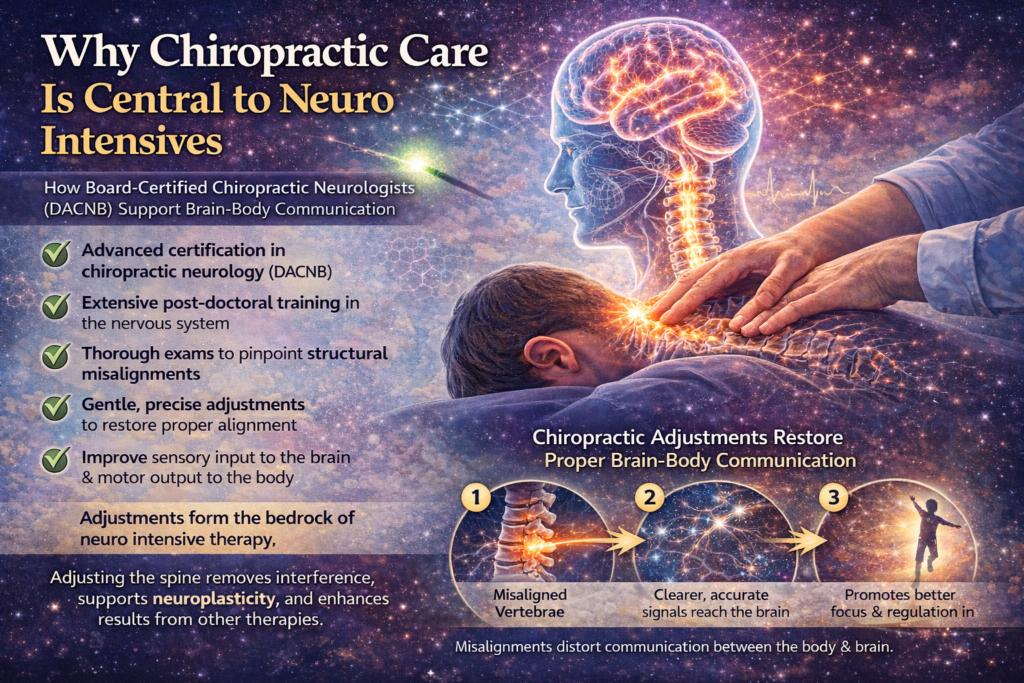
- Chiropractic adjustments — gentle, specific spinal adjustments to remove structural interference with nervous system function. When subluxations are present, the brain receives distorted sensory input — chiropractic care helps restore clear communication between the spine and the brain.
Step 4: Daily Monitoring and Real-Time Adjustments
One significant advantage of the intensive format is that Dr. Condos observes your child every single day. If a particular approach is producing a strong response, he can build on it immediately. If something needs to be adjusted, it can be modified the next morning — not three weeks later at the next appointment.
Step 5: Progress Evaluation and Home Care Plan
At the end of the program, Dr. Condos evaluates your child’s progress against the initial assessment and provides a detailed home care plan — exercises and strategies your family can continue to support neurological development after you leave. Many families return every 3–6 months for follow-up intensives to maintain and extend the gains made.
Why Chiropractic Care Is Central to Neuro Intensives
For many people, chiropractic care still conjures an image of cracking backs for lower back pain. That’s an outdated picture — especially when it comes to chiropractic neurology.
A board-certified chiropractic neurologist (DACNB) has completed extensive post-doctoral training — equivalent to thousands of hours of coursework and clinical examination — specifically in how the nervous system functions, develops, and heals. Dr. Condos earned his DACNB in 2016 and has since accumulated thousands of additional hours of post-doctoral education in functional neurology, pediatric neurodevelopmental disorders, concussion rehabilitation, vestibular therapy, and functional medicine.
The spine and brain are not separate systems. The spinal cord is literally the information superhighway between the body and the brain. When there is structural misalignment — a subluxation — anywhere along the spine, it can distort the sensory signals the brain receives, interfere with motor output, and contribute to the dysregulation patterns seen in many developmental conditions. Chiropractic adjustments within a neuro intensive program aren’t an add-on. They’re a core mechanism for supporting the brain-body communication that every other therapy in the program depends on.
This integration of chiropractic neurology with vestibular therapy, vision therapy, primitive reflex remediation, and laser therapy is what distinguishes a neurointensive program from traditional chiropractic care — or from traditional occupational and speech therapy alone.
What Results Can Parents Expect?
Every child’s nervous system is different, and no ethical provider promises specific outcomes. What we can tell you is what families at North Lakes Chiropractic consistently observe during and after the 1–2 week program:
- Better focus and sustained attention
- Reduced hyperactivity and impulsivity
- Improved emotional regulation and fewer meltdowns
- Better balance and coordination
- Improved speech and communication
- Reduced sensory sensitivities
- Better sleep patterns
- Academic improvement
- Increased social engagement
- Greater confidence and self-awareness
Neuro intensive therapy is not a cure. Results vary by child, by condition severity, and by how consistently home care exercises are maintained afterward. What the program consistently delivers is meaningful, measurable progress — and a neurological foundation that supports continued development long after the program ends.
Neuro Intensives vs. Traditional Weekly Therapy
Understanding how neuro intensives differ from conventional therapy can help you decide whether the program is the right fit for your child:
| Neuro Intensives at North Lakes | Traditional Weekly Therapy | |
| Schedule | 1–2 hrs daily, 1–2 weeks | 30–60 min weekly, months+ |
| Approach | Targets multiple neurological systems simultaneously | Addresses specific functional areas (speech, motor, etc.) |
| Assessment | Comprehensive neurological evaluation of brain function, reflexes, vestibular & visual processing | Area-specific evaluation |
| Momentum | Daily gains build on each other through concentrated stimulation | Progress can stall between weekly appointments |
| Lead Provider | Board-certified chiropractic neurologist (DACNB) | Varies by specialty |
| Best For | Children needing focused neurological intervention, or who haven’t progressed with traditional therapy | Ongoing skill maintenance and reinforcement |
The two approaches aren’t mutually exclusive. Many families who participate in our program continue with occupational therapy, speech therapy, or ABA — and find that those therapies become more effective once the underlying neurological barriers have been addressed.
Common Questions Parents Ask About Neuro Intensives
My child isn’t hitting milestones. Is it too late to start?
Neuroplasticity is most robust in younger children, which is why earlier intervention tends to produce faster results. But the brain retains the capacity for change at any age. Dr. Condos works with children of all ages — and in many cases, children who seemed to have plateaued in their development make significant gains through neurointensive therapy.
Is this a non-medication approach to ADHD?
Yes. Our program is 100% non-medication. We identify and treat the underlying neurological dysfunction — such as retained primitive reflexes, vestibular dysregulation, or visual processing deficits — that contribute to attention and behavioral symptoms. For some families, this reduces or eliminates the need for medication. For others, it complements an existing medication plan. We work with your family to find the right path.
We’ve tried a lot of therapies. How is this different?
Our program starts with a comprehensive neurological evaluation that looks at systems most traditional therapies don’t assess — retained primitive reflexes, vestibular function, visual processing, and full brain-body integration. Many children who haven’t responded to conventional therapy have underlying neurological dysfunction in these areas that was never identified. Once those root causes are addressed, the neurological foundation for all other development improves.
Is neuro intensive therapy safe for children?
Yes. All therapies used in our program are non-invasive and non-medication. Dr. Condos is a board-certified chiropractic neurologist with over a decade of clinical experience and thousands of hours of specialized training in pediatric neurological care. The program is carefully designed to stay within each child’s individual tolerance.
Do we need to live in Grand Rapids?
No. Families travel from across Minnesota — the Twin Cities, Duluth, Rochester, and beyond — because the 1–2 week intensive format makes the trip practical. You come once for concentrated care, not repeatedly for weekly appointments. Grand Rapids is located 3–4 hours from Minneapolis/St. Paul and 1.5 hours from Duluth, with lodging options that accommodate families during the program.
About Dr. Kolby Condos, DC, DACNB
Dr. Kolby Condos is a board-certified chiropractic neurologist (Diplomate of the American Chiropractic Neurology Board, or DACNB) — the highest certification available in the field of chiropractic neurology, requiring extensive post-doctoral education and national board examination. He earned his DACNB in 2016 after completing his Doctorate of Chiropractic at Northwestern Health Sciences University.
Since then, he has completed thousands of hours of additional post-doctoral training in functional neurology, pediatric neurodevelopmental disorders, concussion rehabilitation, vestibular therapy, vision therapy, primitive reflex integration, functional medicine, and laboratory analysis. He co-founded North Lakes Chiropractic & Functional Neurology with his wife, Dr. Dajana Condos, and has been providing neurointensive programs in Grand Rapids for over a decade.
His clinical focus is on identifying the root causes of neurological and developmental dysfunction — not managing labels — and restoring balance through personalized, evidence-informed care. He is especially passionate about helping children reach their fullest neurological potential, and about giving families the hope and practical tools they need to move forward.
Ready to Take the Next Step for Your Child?
If your child is struggling with developmental delays, autism, ADHD, sensory processing challenges, or learning difficulties — and you’re looking for a different approach — a neuro intensive program at North Lakes Chiropractic & Functional Neurology may be the next step.
The first step is a comprehensive neurological assessment with Dr. Kolby Condos. That evaluation tells us exactly which neurological systems need support and whether a neurointensive program is the right fit for your child. There’s no obligation to begin a program until you understand the findings and have had your questions answered.
We serve families in Grand Rapids, the Twin Cities, Duluth, Rochester, and across Minnesota. Most families find that the 1–2 week concentrated format is entirely manageable — even when traveling from a distance.
Ready to explore neuro intensive therapy for your child? Visit our comprehensive Neuro Intensive Therapy for Children page to learn more about our program, or call North Lakes Chiropractic at (218) 999-7006 to schedule your child’s assessment.